- Digital Marking System for CBSE
- +91 9229113533
- +91 9229113566
- info@addmengroup.com
- Send Query
- Available as OEM on GeM

This page answers frequently asked questions related to question paper making rules used with the Addmen Group Question Paper Generator (QPG) Software. These rules ensure that generated question papers are consistent, balanced, compliant with exam standards, and ready for printing or online use.
The rules below apply whether you are preparing objective tests, subjective papers, mixed assessments, or customized exams using the QPG tool.
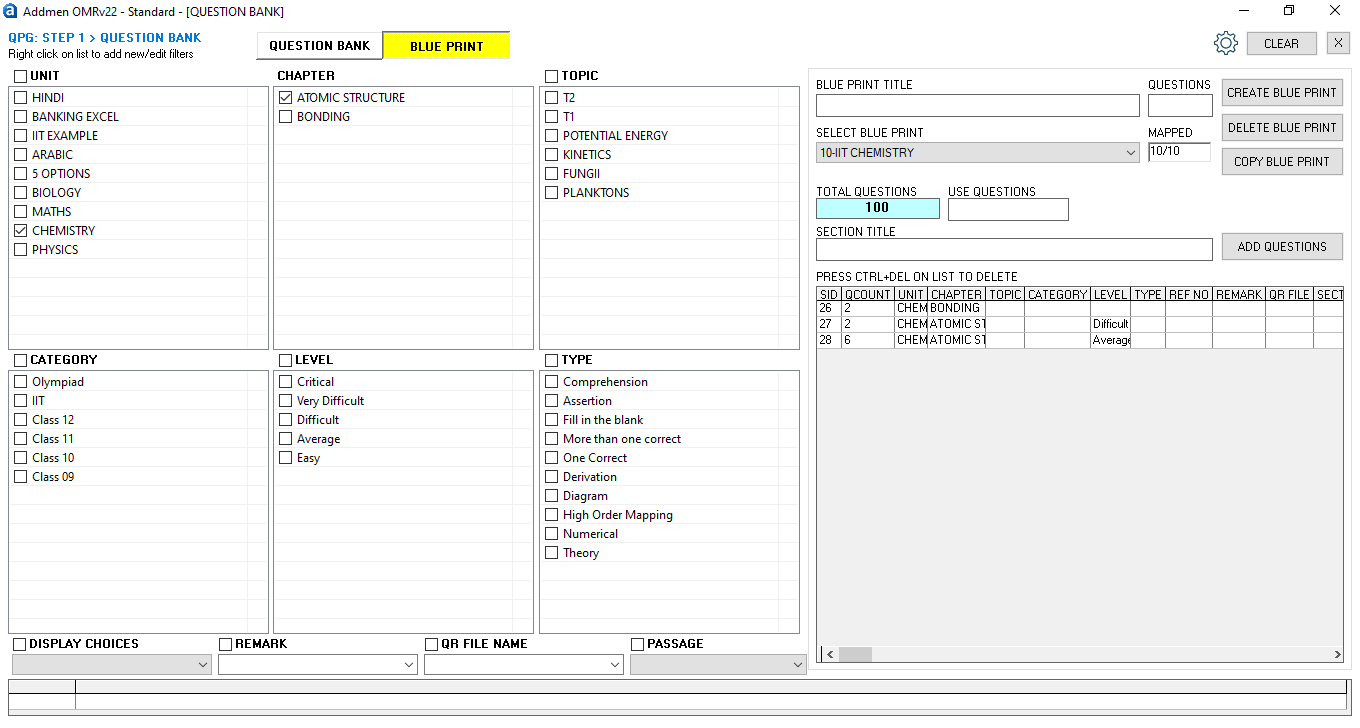
When generating a paper with the software, you should define a blueprint that guides the selection of questions. The basic rules include:
Include the total number of questions required.
Specify subject areas, chapters, or units from which questions will be drawn.
Ensure mark distribution meets your exam structure (for example, equal weight to each section or topic).
Define difficulty levels if required, such as easy, moderate, and difficult questions, so the software can distribute questions accordingly.
These rules help the software fetch relevant questions and avoid unbalanced or incomplete papers.
A blueprint sets the structure of your question paper. When defining a blueprint:
The software displays the number of available matching questions at every step so you can adjust requirements as needed.
Yes. The QPG software prioritizes least-used questions when generating new papers so that repetition is minimized across different sets.
If the question bank has insufficient fresh questions meeting the blueprint criteria, then previously used questions may be selected as needed.
Question papers generated using QPG can include multiple sections based on requirements. Some rules you should follow:
Divide the paper into logical sections or parts such as Part A, Part B, etc., if required by your exam format.
Each section can have questions from specific topics or units.
Mark distribution and number of questions per section should be specified in the blueprint.
This ensures that each section of the paper aligns with your defined educational outcomes.
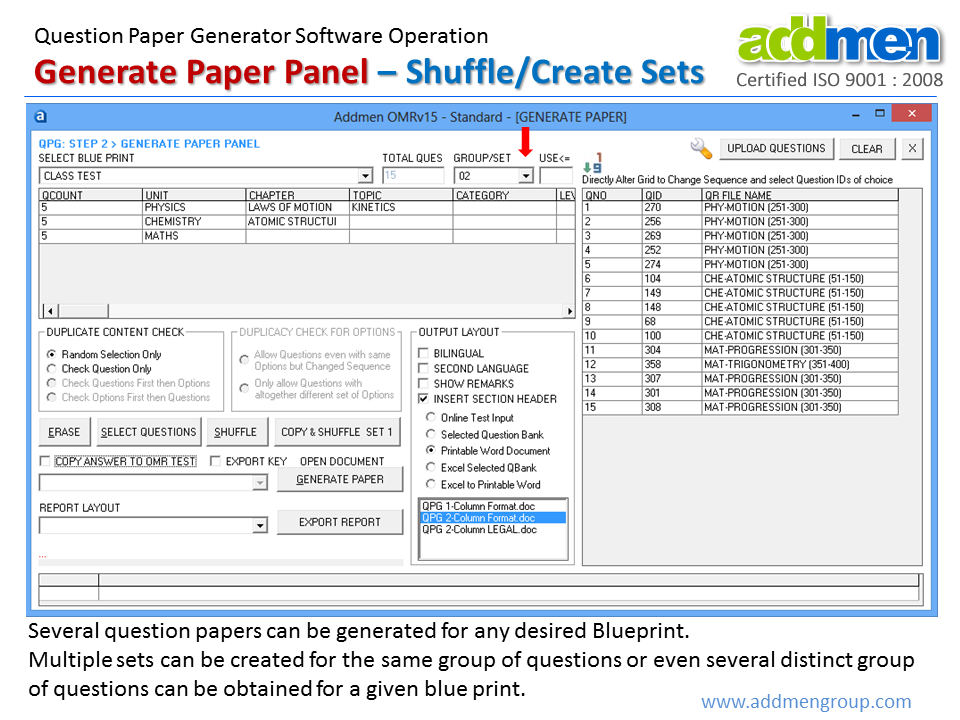
When generating multiple sets of the same paper:
Use the question shuffling facility to create distinct sets.
Shuffling occurs within sections, so the structure of the paper stays intact but the order of questions changes.
The corresponding answer key is also shuffled appropriately.
Shuffling improves exam integrity by reducing the risk of cheating or copying in paper‑based or classroom tests.
Yes. The numbering or lettering pattern for MCQ options can be specified in the software:
This flexibility ensures compatibility with your existing evaluation systems.
When generating the final paper:
Select a print or digital format that meets your needs (Word or PDF).
Ensure headers, footers, and institutional logos are applied consistently.
Include exam title, instructions, duration, total marks, and section labels on the first page.
For competitive or formal exams, include candidate details sections if the output will be used for answer sheets or OMR sheets.
These formatting rules enhance clarity and professional presentation.
If you need a bilingual question paper:
Prepare question banks in both languages.
The software does not auto-translate content; both language versions must be available in your question bank.
You can generate papers in one language, both languages side by side, or generate separate language variants.
This is useful for regionally tailored exams or multilingual academic environments.
Yes. You can adapt question paper making rules to suit:
School or board exam formats with specified section formats and marks.
Competitive test formats requiring precise distribution of difficulty and topic weights.
Online tests with adaptive or segmented structures.
Certification exams with strict blueprint requirements.
By using filters and blueprint rules, you ensure that each paper complies with your chosen format and standards.
The QPG software uses your defined rules to:
Select questions from the bank based on classification filters.
Avoid duplication where possible.
Respect section, difficulty, and marks distribution rules.
Generate multiple structured and consistent output papers.
This automated enforcement speeds up question paper generation and maintains consistency across multiple batches.
Introduction & Overview
FAQs on QPG Operation
Operation QPG Software
