- Digital Marking System for CBSE
- +91 9229113533
- +91 9229113566
- info@addmengroup.com
- Send Query
- Available as OEM on GeM

This page answers all frequently asked questions about how multiple choice questions (MCQs) and their answers are classified, tagged, stored, retrieved, and used in Addmen Group’s Question Paper Generator and Multiple Choice Question Software. The answers below explain every aspect of MCQ classification and answer handling so you can build, manage, and generate large-scale test papers easily and correctly.
The software supports a wide variety of question types including:
Multiple Choice Questions (MCQs) with options
True or False questions
Fill in the blanks
Column Matching
Passage-based comprehension questions
Theory questions without options
Numerical problems
Diagram-based questions
These types ensure the tool can be used for objective tests, subjective questions, mixed assessments, and more.
Questions and answers are stored in Word files called Question Resource (QR) files. Each QR file can contain any number of questions, and these files are imported into the Question Bank Software where they become part of the centralized repository.
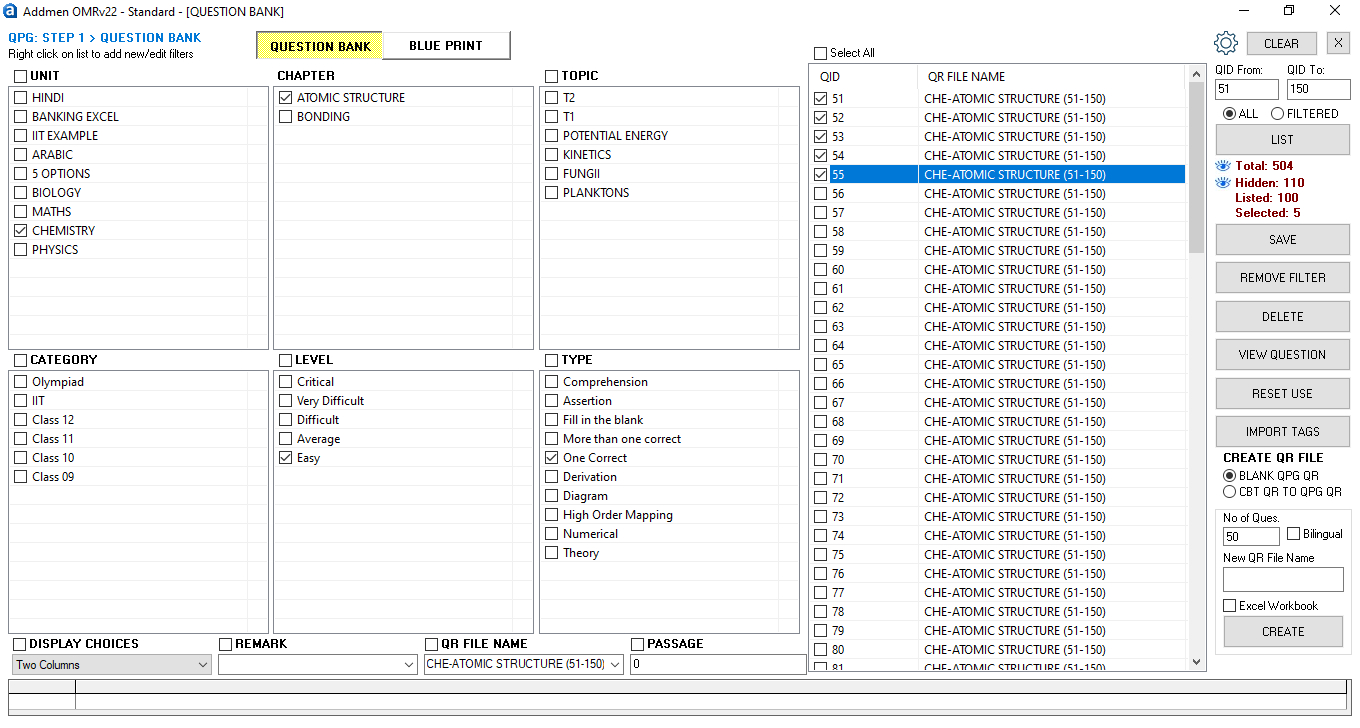
The software then uses classification metadata stored in its internal database to organize and retrieve questions based on filters such as subject, topic, difficulty level, marks, and question type.
You can create any number of QR Word files in your computer or server. These files are indexed and managed by the question bank software. Organizing questions topic-wise or chapter-wise is recommended for easier editing and quick access, especially when managing larger banks.
Though you can name QR files as desired, naming them logically (such as by topic or subject) improves convenience and usability.
There is no fixed limit to the number of questions per QR file. However, to maintain performance and ease of navigation, it is generally advisable to keep a QR file to a moderate size, for example around 200 questions. This helps editing and quick retrieval without making files too heavy for system processing.
Yes. The system is not limited to MCQs. You can include:
Theory or descriptive questions
Passage-based comprehension questions
Numerical problems
Fill in the blank or structured response questions
True/False formats
This makes the software suitable not only for objective tests but also for mixed question papers and subjective assessments as well.
Yes. You can edit QR Word files and their contents either directly through the software’s interface or outside the software using Word itself. Opening the QR file associated with a question allows you to make corrections or updates quickly.
The system supports multiple classification filters including:
Subject
Unit or category
Chapter
Topic
Difficulty level
Marks level
Question type
These filters help the software retrieve appropriate questions when generating a paper according to a selected blueprint. You can also create user-defined filters like nested sequences (for example, Unit → Chapter → Topic) or standalone ones like difficulty or type.
When a test blueprint is defined, the software searches the question bank for questions that match the specified criteria. The retrieval mechanism usually involves:
Random selection from matching categories
Priority given to questions used least often to avoid repetition
Excluding certain questions manually if required
This approach ensures diverse and balanced papers that adhere to exam requirements.
Yes. The system is designed to prefer questions that have been used less frequently during random selection. This prioritization minimizes repetition across multiple papers, especially when generating set after set for large test programs.
A blueprint is created through the blueprint panel, where you specify:
Number of questions
Subjects or units
Difficulty levels
Marks
Question types
Filter criteria (such as topic or category)
The software displays how many qualifying questions are available before you finalize the blueprint and generate the paper.
There is no restriction on the number of blueprints you can create. Each blueprint can be saved for later reuse. Similarly, you can generate multiple question papers from a given blueprint. Unless there is a shortage of new questions, each generated set will be unique.
The software’s Question Shuffler module enables creation of many sets of the same paper. Shuffling occurs within each section without mixing questions across sections, and corresponding answer keys are shuffled alongside.
The Question Paper Generator software provides outputs suitable for different use cases:
Printable formats for pen-and-paper based exams
Soft copy formats that can be used as inputs to Online Test Systems or LMS platforms
Output formats are typically Word or PDF files that can be further edited or directly printed.
Yes. Bilingual papers can be generated if you have prepared QR files for both languages. The software does not auto‑translate; instead both language question banks must be present. You can also choose to print only one language or the second language alone.
The numbering style for MCQ options can be customized. You can choose patterns such as 1,2,3,4 or A,B,C,D or a,b,c,d or i,ii,iii,iv depending on the requirement of your test format.
Yes. Users can create custom Word templates that the software uses when generating question papers. These templates can include:
This allows institutions to produce institution-branded professional output seamlessly.
The software provides classification details of questions along with the generated paper. It also allows retrieval of the question shuffle mapping used for creating multiple sets. This aids analysis and consistency checks.
The Question Paper Generator (also referred to as Question Bank Software) is ideal for creating:
Assignments
Practice tests
Weekly tests
Full test series
Online assessments
This eliminates repetitive manual work and speeds up test creation, especially for institutions that conduct frequent testing such as coaching institutes for competitive exams.
Introduction & Overview
FAQs on QPG Operation
Operation QPG Software
