- Digital Marking System for CBSE
- +91 9229113533
- +91 9229113566
- info@addmengroup.com
- Send Query
- Available as OEM on GeM

OMR scanning methods have evolved significantly over time. Earlier systems relied on dedicated OMR machines, but modern solutions like Addmen OMR Software use standard scanners and image-based processing to evaluate answer sheets efficiently. Today, OMR scanning is not limited to hardware devices—it is a software-driven workflow where scanned images are analyzed, interpreted, and converted into structured data for evaluation.
In older systems, OMR sheets were processed using dedicated hardware machines.
How it worked:
Sheets were fed into OMR machines
Optical sensors detected filled bubbles
Data was directly processed by machine software
Limitations:
Expensive hardware dependency
Limited flexibility in sheet design
Difficult scalability
High maintenance requirements
This method is now largely replaced by software-based systems.
Modern systems like Addmen OMR Software use a completely different approach:
Process:
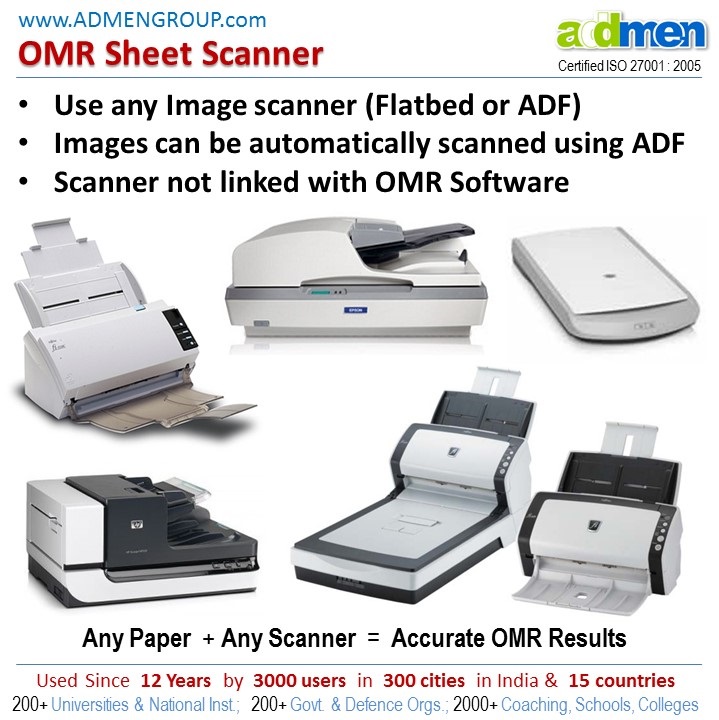
Sheets are scanned using any standard scanner
Images are saved in formats like JPG, TIFF, or BMP
Software processes images and detects responses
Results are generated automatically
This eliminates the need for specialized OMR machines.
1. Flatbed Scanner Method
Used for small-volume OMR processing.
Features:
One sheet at a time
High clarity scanning
Simple workflow
2. ADF Scanner Method
Most commonly used for bulk scanning.
Features:
Automatic sheet feeding
Continuous batch scanning
Faster processing workflow
3. High-Speed Document Scanner Method
Used in large-scale examination systems.
Features:
Addmen OMR Software follows an image-based scanning method:
Workflow:
Scan OMR sheets using any scanner
Save images in a folder
Software reads bubbles, OCR, barcode, or ICR fields
Auto-alignment and correction applied
Results generated automatically
This method is highly flexible and hardware-independent.
For accurate OMR processing, scanning settings are important:
Supported formats:
JPG
TIFF
BMP
Recommended settings:
DPI: 100–200
Mode: Color or grayscale depending on sheet design
Avoid unnecessary compression
These settings ensure optimal recognition accuracy.
Scanner independence (any brand or model)
Auto-alignment and skew correction
Batch processing capability
Support for OCR, ICR, barcode, QR
Color dropping for multi-color sheets
High accuracy image recognition
Traditional Method
Hardware-based OMR machines
Fixed workflow
Limited flexibility
Modern Method (Addmen OMR Software)
Software-based processing
Uses standard scanners
Highly scalable and flexible
Lower infrastructure dependency
No dedicated machine required
Works with existing scanners
Faster deployment and setup
Suitable for large-scale exams
Easy integration with digital systems
Flexible sheet design and processing
Maintain consistent scanner settings across batches
Ensure all corner marks are visible
Avoid folded or damaged sheets
Use proper DPI settings
Store scanned images in organized folders
Prefer batch scanning for efficiency
OMR scanning methods have shifted from hardware-based machines to intelligent software-driven systems. Addmen OMR Software enables institutions to use standard scanners for capturing images while performing advanced recognition and evaluation through software. This modern approach offers greater flexibility, scalability, and efficiency for educational and examination systems.