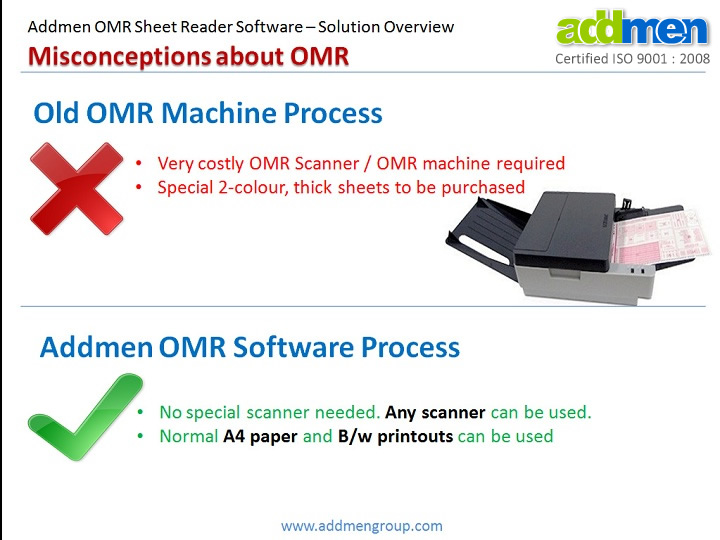
OMR technology has evolved significantly over time. Earlier, institutions relied on dedicated OMR machine scanners for evaluating answer sheets. These machines required special paper, high investment, and physical maintenance.
Today, modern solutions like Addmen OMR Software have replaced traditional machines by using standard scanners and intelligent image processing. This shift has made OMR systems more affordable, flexible, and scalable for schools, universities, and recruitment agencies.
An OMR machine is a dedicated hardware device designed specifically to scan and read marked bubbles on answer sheets.
Key Characteristics
Built-in scanning hardware
Requires special OMR sheets
Fixed processing system
High-speed mechanical feeding system
Expensive installation and maintenance
Traditional OMR machines were widely used in large exam centers but have limitations in flexibility and cost efficiency.
OMR software is a modern digital system that reads scanned images of OMR sheets using algorithms instead of dedicated hardware.
According to Addmen’s OMR system, software-based solutions work with normal scanners and eliminate the need for expensive OMR machines.
Key Characteristics
Works with standard flatbed or ADF scanners
Processes image-based OMR sheets
Supports OCR, ICR, barcode, and QR integration
Highly customizable templates
Software-driven evaluation and reporting
OMR Machine
Very high upfront investment
Maintenance and servicing costs
Limited upgrade flexibility
Requires dedicated infrastructure
OMR Software
One-time software license
Works with existing scanners and PCs
Minimal maintenance cost
No hardware dependency
Software-based systems significantly reduce total cost of ownership.
OMR Machine
High fixed scanning speed
Limited scalability beyond machine capacity
Requires physical handling for each batch
OMR Software
Batch processing capability
Can handle thousands of sheets per hour in optimized systems
Parallel processing possible on multiple systems
Software scales better for large exam volumes.
OMR Machine
High accuracy in controlled environments
Sensitive to paper quality and alignment
May reject skewed sheets
OMR Software
Auto-alignment and skew correction
Handles imperfect real-world scans
Adjustable detection sensitivity
Flags uncertain responses for review
OMR Machine
Fixed sheet formats
Limited customization
No OCR/ICR capability
Hardware-bound upgrades
OMR Software
Drag-and-drop sheet design
Supports OCR, ICR, barcode, QR
Advanced reporting and analytics
Easy updates and feature upgrades
OMR Machine
Requires additional machines for expansion
Expensive multi-location deployment
Limited distributed processing
OMR Software
Easily deployable across multiple centers
Supports centralized or distributed processing
Scales with hardware resources
OMR Machine
Mechanical wear and tear
Requires servicing and calibration
Expensive replacement parts
OMR Software
Software updates are simple
No mechanical failure risks
Remote upgrades possible
Lower cost of operation
No special hardware required
Faster deployment across locations
Better integration with digital systems
Advanced analytics and reporting
Easier scalability for large exams
OMR machine systems represent the traditional approach to Optical Mark Recognition, but they are expensive, rigid, and hardware-dependent. Modern OMR software solutions like Addmen provide a more flexible, scalable, and cost-effective alternative by using standard scanners and intelligent processing.
For most educational institutions, recruitment bodies, and survey organizations, OMR software is now the preferred choice due to its efficiency, affordability, and adaptability.