- Digital Marking System for CBSE
- +91 9229113533
- +91 9229113566
- info@addmengroup.com
- Send Query
- Available as OEM on GeM

The Addmen OMR Sheet Design module is included free with the main OMR software. It lets institutions, exam bodies, and organizations design, export, and print custom OMR sheets, answer sheets, application forms, surveys, ballots, attendance sheets, and more, without buying separate design tools.
The design interface is intuitive — simply drag and drop the bubble matrix or desired answer blocks onto the page.
After placing the technical OMR elements (bubbles, codes, ID-blocks), you can export the layout and add custom text, institute logos, instructions, or other branding using external editing tools (like CorelDraw or open-source editors).
Designed sheets can then be printed using standard printers (laser, inkjet), or via offset / resograph — no special pre-printed stock needed.
You can design virtually any kind of OMR-based sheet depending on your needs:
| Use Case | Description |
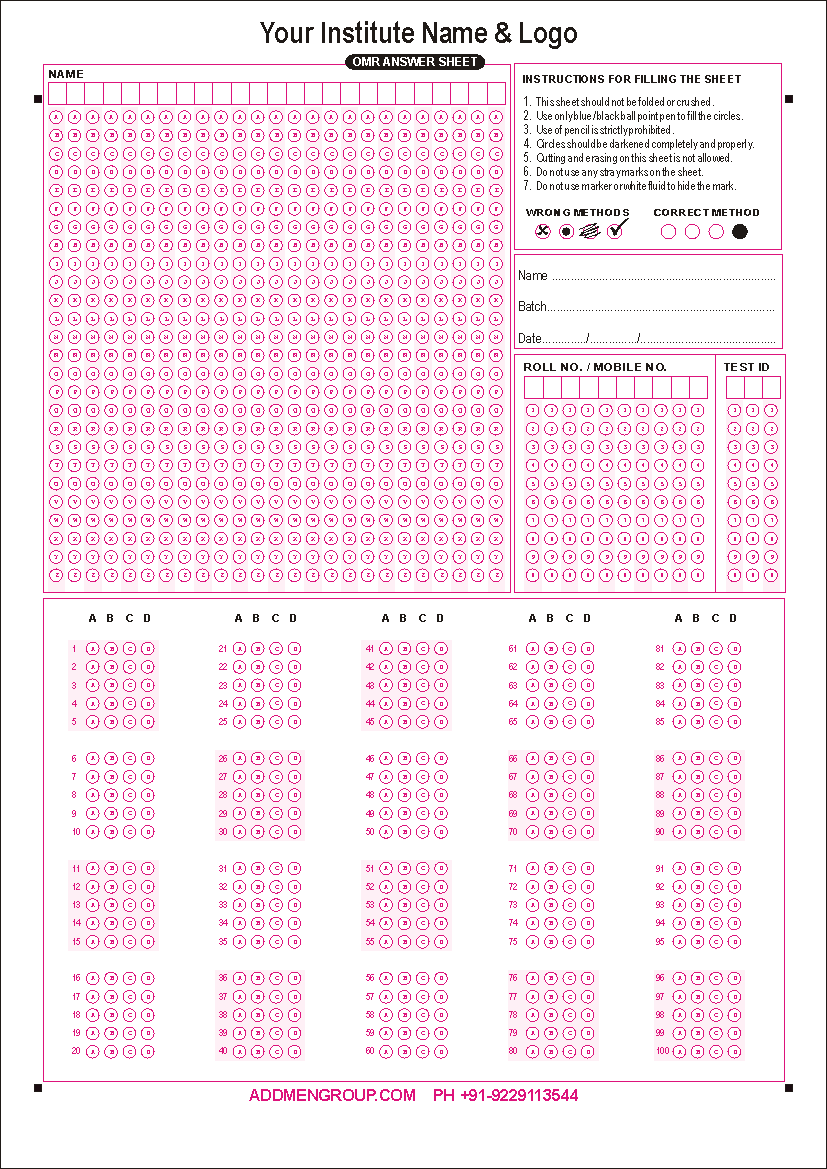
| OMR Answer Sheets | For multiple-choice exams, tests or assessments — ideal for objective-type questions. |
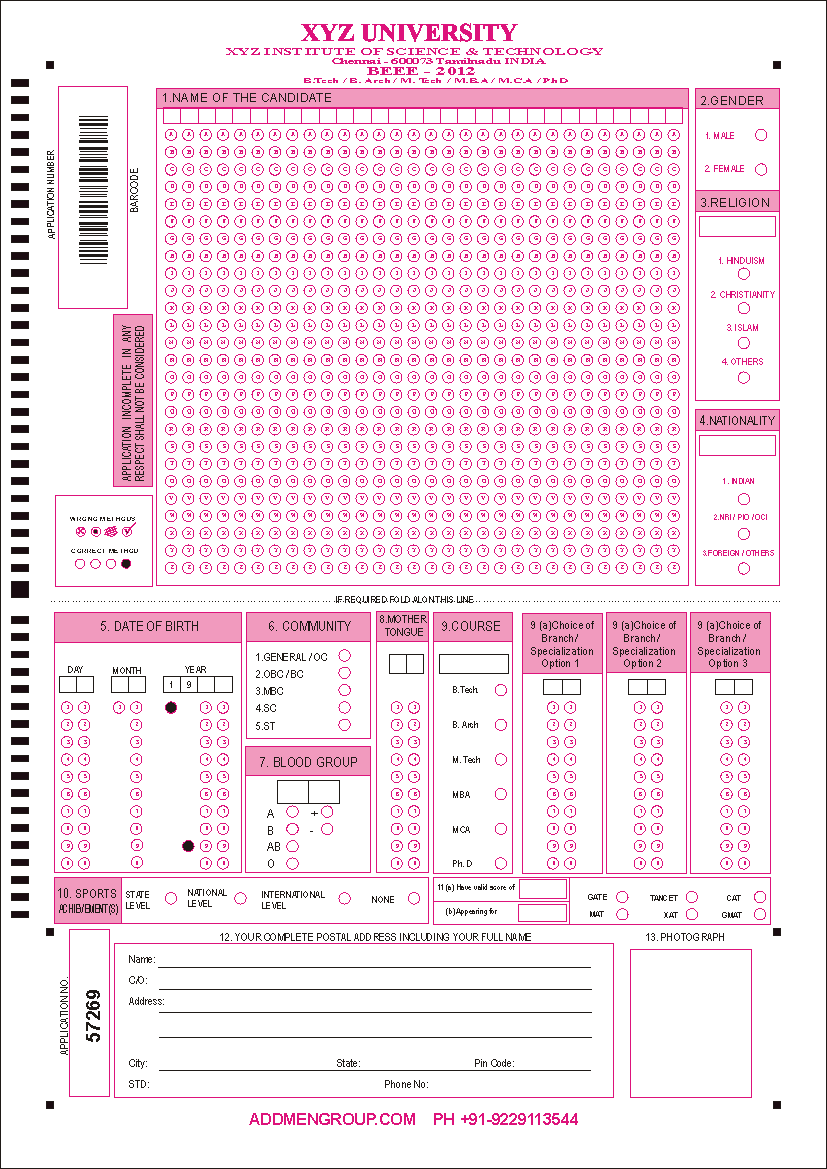
| Application / Registration Forms | For admissions, registrations, surveys — collect structured data from large groups. |
| Hybrid / Special-Purpose Sheets | Attendance logs, mark sheets, ballots, quality cards — mix of data collection & responses. |
| Custom Data-Collection & Surveys | Feedback forms, questionnaires, surveys — process responses digitally with OMR. |
There is no limit on the number of designs you can create — from small forms to large A3 sheets. Duplex (two-sided) sheets are also supported.
With Addmen’s designer you can combine various block types on a single sheet for maximum flexibility:
MCQ / Standard multiple-choice bubble grids
Matrix-type blocks (for matching or grouped questions)
Integer-type / numeric-answer blocks (for numeric responses)
Alphanumeric blocks (for roll numbers, codes, mixed-character IDs)
Barcode / lithocode fields (for automated identification)
OCR / ICR fields (to capture printed or handwritten text/data)
Image/Signature blocks — for photos, signatures, or scanned images — along with OMR bubbles, enabling hybrid forms.
This flexibility allows you to build anything: from simple MCQ answer sheets to complex application forms with ID, data fields, and response sections — all in one sheet.
Once the layout is ready, export can be done in color or black & white depending on your requirements.
Exported designs can be opened in any graphic editing tool to add logos, instructions, header/footer, or decorative text.
Sheets can be printed using laser, inkjet, resograph or offset printers — giving flexibility for small or mass print runs.
For sheets designed within Addmen’s software, automatic calibration ensures correct alignment — so you don’t need separate calibration steps.
If you are using older or externally created bubble sheets, the software also supports calibration of pre-printed sheets, enabling them to be used with modern scanning workflows.
To ensure accurate scanning and evaluation:
Always include index points in all four corners — essential for scanner alignment.
Maintain correct bubble/grid spacing and size — typical bubble grid size range is 45–60 pixels for optimal readability.
Keep sufficient spacing between bubbles — avoid overcrowding, which can cause misreads or multiple-mark errors.
Do not alter bubble positions, sizes, or index markers after exporting the layout. Any change can break calibration.
Ensure printing is crisp — bubble outlines must be thin, clear, and consistent; printing quality (laser/offset preferred) improves scanning reliability.
If using duplex (two-sided) sheets or large bubble sets, test print and scan a sample sheet before full production to verify alignment and readability.